
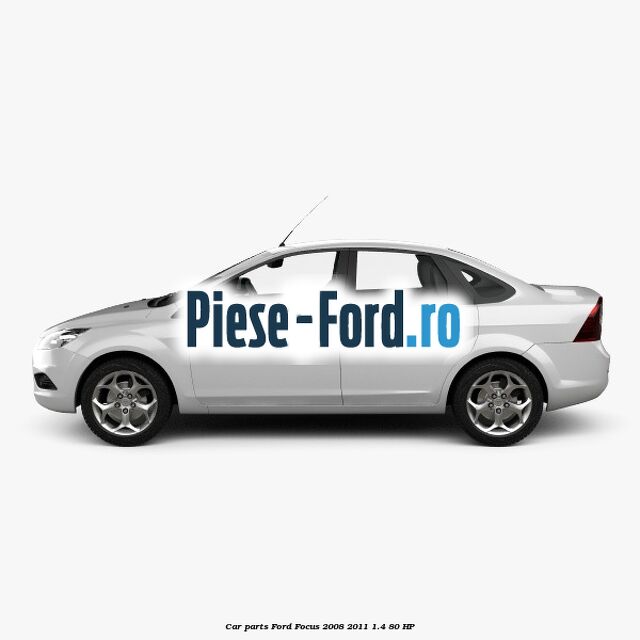


Ford FOCUS Parts | 2008 - 2011 | Mk2 Duratec Duratorq #667O2785K
When you are at the top, everyone tries to bring you down, either by copying the qualities that attracted you to that preeminent position. This is why reaching the top is one thing, but staying there is a much harder task altogether. Despite the difficulties involved, the Ford Focus 2 enjoyed an extended reign over the family hatchback segment that began with the launch of the initial model in 1998 and continued when the second generation arrived in 2005. The facelifted Ford Focus model was introduced in 2008. What changed? Mostly, Ford introduced the Kinetic design themes that took a storm right across the model range from Mondeo to Focus. The key element of this was the twin trapezoidal grilles, which dominated the front, but the headlights and flared wheels also formed an integral part of the look. Ford must have liked it because by 2010, every passenger car model would feature these characteristics in one form or another. There were also changes where the Focus began to feel less plush than some of its rivals. Soft-touch plastics were introduced, along with higher quality fabrics and redesigned controls. Three-door and five-door hatchbacks were available, along with a saloon and an estate, but the Focus family also extended to the Coupe-Cabriolet convertible model and the compact MPV C-MAX. The engine range remained unchanged and expansive: naturally aspirated petrol engines of 1.4, 1.6, 1.8, and 2.0 liters were offered, as well as a 2.5-liter turbo petrol from the ST and TDCi diesel units with capacities of 1.6, 1.8, and 2.0 liters. The 1.6 TDCi engine powered the super-efficient econetic models, which achieved stop/start technology and CO2 emissions below 100g/km CO2 at the end of 2009. Just before this, Ford introduced the impressive Powershift dual-clutch automatic gearbox. On December 17, 2007, Ford of Europe confirmed that a Mk 2 Focus RS would be launched in 2009. The press release also notes that a conceptual version of the RS is due in mid-2008. [10] Contrary to numerous rumors and speculations, the RS was announced by Ford to have a conventional FWD design with an upgraded Duratec ST engine with 305PS Duratec RS, gearbox, suspension, and LSD. As announced, the Focus RS MK2 hit the road on January 5, 2009. When Ford completed the Mk I production series, Fords UK managing director, Paul Thomas, stated: "We always knew the Focus RS would be a sales winner, but we could never have predicted the fantastic reception and the effect it had in rekindling the passion for the Ford RS brand." In 2008, Ford unveiled the new Focus RS in "concept" form at the British International Motor Show. The Duratec RS engine was upgraded to produce 305 hp (224 kW; 301 PS) at 6500 rpm and 440 N·m (325 lb·ft) of torque at 2250-4500 rpm. Acceleration from 0 to 100 km/h was rated under 6 seconds. The RS uses a modified Volvo 2,522 cc (2.5 L; 153.9 cu in) inline-five engine found in the Focus ST. A larger BorgWarner K16 turbo now provides a boost of up to 20.3 psi (1.40 bar). A new air-to-air intercooler was developed as a complement, while the forged crankshaft, silicon-aluminum pistons, graphite-coated cylinder bores, a compression ratio of 8.5:1, and variable valve timing also increase power. The car remains front-wheel drive, but to reduce torque steer, a Quaife Automatic Torque Biasing LSD and a specially designed MacPherson front suspension called RevoKnuckle are used, which ensures a smaller scrub radius and pivot offset than traditional models while avoiding the increased weight and complexity of double wishbone and multi-link suspension setups. Ford UK claims: "Its as close as youll get to driving a full rally car (Ford Focus RS WRC). 0-100 kilometers per hour: 5.9 s. Top speed: 263 kilometers per hour. Kilometer from a standstill: 25.4 s (the fastest front-wheel-drive car in this special exercise - this time was recorded by the Belgian magazine Le Moniteur Automobile). At the back, a dramatic spoiler creates a novel look. The Focus RS is available in three expressive exterior colors: Ultimate Green, Performance Blue, and Frozen White. The Focus RS has an exclusive classic Ultimate Green reminiscent of the 70s Ford Le Mans Green from the Ford Escort RS1600 era. Focus RS500 was launched in April 2010. A limited production series of 500 units (101 of these for the UK). It has a 2.5 L5 turbo petrol engine, producing 345 hp (257 kW; 350 PS) and can do 0-62 mph in 5.4 seconds, with a top speed (266 km/h) making it the fastest Focus. The new model received the RS500 designation to highlight its strict production number of 500 individually numbered vehicles, all of which were offered for purchase to customers. Each RS500 carries a metal plaque on the center console, hand-engraved with a unique identification number from 001 to 500. To provide the RS500 with a suitable power unit, the 2.5-liter 305 hp (224 kW; 301 PS) Duratec RS turbo engine was upgraded to deliver significantly higher top and mid-range power. Maximum power is increased by 45 hp (33 kW; 44 PS) to 350 hp (257 kW; 345 PS) at 6,000 rpm, while torque was increased from 440 to 460 N·m (340 lb·ft), delivered over a wide speed range of 2,500 to 4,500 rpm. Modifications include a significantly larger air-to-air intercooler to provide a cooler, denser charge; a larger air filter box for increased airflow; larger diameter exhaust pipe; and an improved fuel pump, along with updated software calibration to optimize the revised engines performance. Preliminary performance figures for the Focus RS500 indicate it reaches 0–100 km/h in 5.6 seconds, with a top speed similar to the standard RS at 263 km/h. Designed by Performance Car Engines, the Focus RS500 engine was modified by a team from Ford Team RS in partnership with Revolve Technologies, the automotive engineering firm that develops Ford-approved performance upgrades through its Mountune Performance brand. All Focus RS500 vehicles will be painted in a standard Panther Black metallic color before being shipped to a dedicated 3M facility near Frankfurt, Germany, where a special film will be applied to the body to create the matte black effect. Focus BEV Focus BEV similar to the one shown on The Jay Leno Show A prototype battery electric vehicle Focus was demonstrated in August 2008. The variant, sometimes known as the "Focus EV." The concept shown at the 2009 Frankfurt Motor Show was developed to participate in the UK governments "Low Carbon Vehicles" demonstration initiative in early 2010. A consortium consisting of Ford, Scottish and Southern Energy, and the University of Strathclyde will use a fleet of 15 Ford Focus BEVs and a charging infrastructure in and around the London Borough of Hillingdon from early 2010. This new BEV demonstration fleet is partially developed with public funding from the UK Governments Technology Strategy Board (TSB), which promotes industry-led innovative projects that reduce CO2. As a publicity stunt, the Focus BEV was featured on The Jay Leno Show in a segment called "Green Car Challenge," where celebrity guests drove the electric car. Focus RS WRC is a version built for the BP Ford World Rally Team by Ford and M-Sport, developed to compete in the World Rally Championship. RS stands for Rallye Sport and WRC for World Rally Car, the FIA specification of the car. Like all contemporary World Rally Cars, the car is heavily modified from the production version, with which it shares only the basic shape and some body parts. The car features four-wheel drive, rather than the front-wheel drive of the production version. The engine used in the 2007 WRC Focus is based on Fords 2.0 Liter Duratec from other models in the Focus range, as rally rules do not allow the standard 2.5-liter engine of the Focus ST or RS road version. As with most rally cars, the 2.0 Liter engine is heavily modified, and performance has been increased using a turbocharger. Also, the 2009 Ford Focus WRC uses a Ford 1998cc Pipo-built l4 Duratec WRC engine (four-cylinder, 16-valve, 85 mm bore, and 88 mm stroke), Pi electronic engine management system, Garrett turbocharger (with required 34 mm intake restrictor), air intercooler, and a catalyst. From the last rally of the 2005 season, Ford campaigned a new model, the Focus RS WRC 06, following the launch of the new version of the car. The engine chosen for this Focus was a Duratec engine developed by French engine specialist Pipo Moteur. The car achieved twelve world rally victories, starting with the opening rally of the 2006 season in Monte Carlo, in the hands of Marcus Grönholm. Focus RS WRC 07 is based on the 2006 model and, according to Fords technical director, Christian Loriaux, "the changes on the new car are mainly to save weight and improve efficiency, driveability, and performance at the lower end of the range." The car debuted with great success at the 2007 Rally Finland, where Fords Finnish drivers Grönholm and Mikko Hirvonen finished first and second. It later made history at the 2008 Swedish Rally when Jari-Matti Latvala used the car to become the youngest driver to win a world rally. Focus RS WRC 08 is based on the 2007 model, Ford Focus WRC 08 seen here for the first time with its new front aero design at the 2008 Rallye Deutschland. It is the first time Hirvonen and Latvala drove the 08 car with the new front design. The 2008 version of the Focus RS WRC includes design style changes as well as engine improvements. The style changes to the grille area reflect the look of the recently previewed Mk II Focus Road sports car. The Focus RS WRC rally car won four times in 2008 and has 36 WRC victories to its credit since the original model debuted in 1999. The current 2009 version of the Focus RS WRC includes minor design style changes. Spare parts for Focus 2 Based on a Focus 1.6. Being Ford, parts are abundant and relatively cheap. A clutch assembly will be around 200 euros, an alternator should be close to 140 euros. The brake set is around 125 euros for a front set, with rear shoes around 45 euros, a replacement headlight is close to 80 euros, and a manual door mirror should be in the region of 50 euros. A complete exhaust is about 250 euros, and a catalytic converter is about 440 euros. Shock absorbers are around 50 euros each. Focus PowerShift Finally, a major manufacturer offers an alternative to the VW DSG dual-clutch gearbox. No, its not Seat, Skoda, or Audi or any other member of the Volkswagen group, but Ford. Fords new Powershift gearbox is the first dual-clutch gearbox for the masses that doesnt come from VW. After all, you cant exactly call the Nissan GT-R, BMW M3, or Ferrari mainstream cars. Now that those performance models have been launched, the technology is starting to filter down to more mainstream models. The automotive industry was rather shocked when the Mk1 Audi TT appeared with DSG. And while VW might be entering its second-generation DSG with the latest seven-speed transmission, we must remember that when Ford is late to the party, it usually does quite well. Remember the C-Max, S-Max, and Kuga? ..So I guess I can have this Powershift gearbox with any engine I want? No. Powershift transmissions can only be connected to the 2.0-liter TDCI engine. You can have a 134 hp version as an option, or a new 108 hp version with standard Powershift transmission (this being more aimed at fleet buyers). The same transmission will also be available in the Volvo C30, S40, and V50.
2026