

Henry Ford
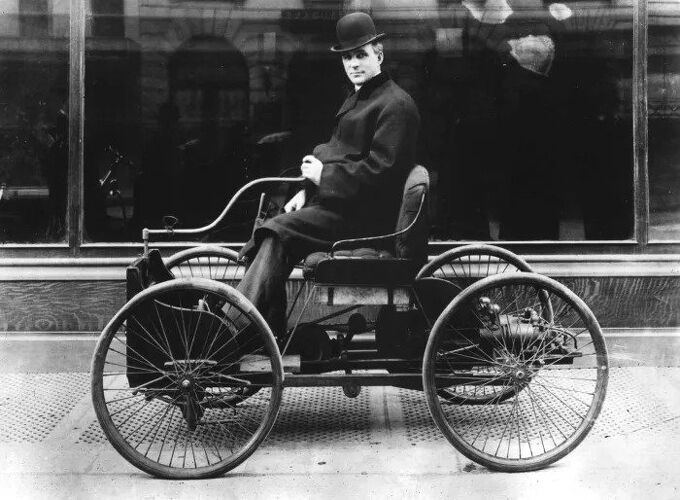
While working as an engineer for the Edison Illuminating Company in Detroit, Henry Ford (1863-1947) built his first gasoline-powered horseless carriage, the Quadricycle, in the shed behind his house. In 1903, he founded the Ford Motor Company, and five years later, the company launched the first Model T. To meet the overwhelming demand for the revolutionary vehicle, Ford introduced new revolutionary mass production methods, including large production factories, the use of standardized, interchangeable parts, and, in 1913, the worlds first moving assembly line for cars. Extremely influential in the industrial world, Ford was also outspoken in the political realm. Ford attracted controversy for his pacifist stance in the early years of World War I and garnered widespread criticism for his anti-Semitic views and writings.
Henry Ford: Early Life and Engineering Career
Born in 1863, Henry Ford was the first surviving son of William and Mary Ford, who owned a prosperous farm in Dearborn, Michigan. At 16, he left home for the nearby city of Detroit, where he found work as an apprentice machinist. He returned to Dearborn and worked on the family farm after three years, but continued to operate and maintain steam engines and occasionally worked in Detroit factories. In 1888, he married Clara Bryant, who grew up on a nearby farm.
Did you know? The mass production techniques promoted by Henry Ford eventually allowed the Ford Motor Company to produce a Model T every 24 seconds.
In the first few years of their marriage, Ford supported himself and his new wife by running a sawmill. In 1891, he returned with Clara to Detroit, where he was hired as an engineer at the Edison Illuminating Company. Rising quickly through the ranks, he was promoted to chief engineer two years later. Around the same time, Clara gave birth to the couples only son, Edsel Bryant Ford. On call 24 hours a day for his job at Edison, Ford spent his irregular hours on his efforts to build a gasoline-powered horseless carriage or automobile. In 1896, he completed what he called the "Quadricycle," which consisted of a light metal frame fitted with four bicycle wheels and powered by a two-cylinder, four-horsepower gasoline engine.
Henry Ford: The Birth of Ford Motor Company and the Model T
Determined to improve his prototype, Ford sold the Quadricycle to continue building other vehicles. He received support from various investors over the next seven years, some of whom formed the Detroit Automobile Company (later the Henry Ford Company) in 1899. His partners, eager to bring a passenger car to market, became frustrated with Fords constant need to improve, and Ford left his namesake company in 1902. (After his departure, it was reorganized as the Cadillac Motor Car Company.) The following year, Ford founded the Ford Motor Company.
A month after the Ford Motor Company was founded, the first Ford car - the two-cylinder, eight-horsepower Model A - was assembled at a plant on Mack Avenue in Detroit. At the time, only a few cars were assembled per day, and groups of two or three workers built them by hand from parts ordered from other companies. Ford dedicated himself to producing an efficient and reliable automobile that would be affordable to everyone; the result was the Model T, which made its debut in October 1908.
Henry Ford: Innovations in Production and Workforce
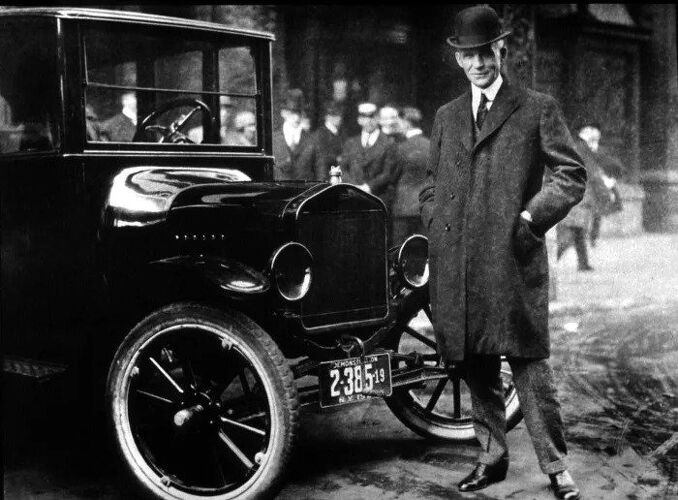
"Lizzie," as the Model T was known, was an immediate success, and Ford soon had more orders than the company could satisfy. As a result, he implemented mass production techniques that would revolutionize American industry, including the use of large production factories; standardized, interchangeable parts; and the moving assembly line. Mass production significantly reduced the time required to produce an automobile, allowing costs to remain low. In 1914, Ford also increased the daily wage for an eight-hour day for his workers to $5 (up from $2.34 for nine hours), setting a standard for the industry.
Even as production increased, demand for the Tin Lizzie remained high, and by 1918, half of all cars in America were Model Ts. In 1919, Ford named his son Edsel president of the Ford Motor Company, but he retained full control over the companys operations. After a legal battle with his shareholders, led by brothers Horace and John Dodge, Henry Ford bought out all minority shareholders by 1920. In 1927, Ford moved production to a massive industrial complex he had built along the banks of the Rouge River in Dearborn, Michigan. The plant included a glass factory, a steel mill, an assembly line, and all other necessary components for automobile production. In the same year, Ford ceased production of the Model T and introduced the new Model A, which had better horsepower and brakes, among other improvements. By then, the company had produced approximately 15 million Model Ts, and the Ford Motor Company was the largest automobile manufacturer in the world. Ford opened factories and operations worldwide.
Henry Ford: Later Career and Controversial Views
The Model A proved to be a relative disappointment and was outsold by both Chevrolet (produced by General Motors) and Plymouth (produced by Chrysler); it was discontinued in 1931. In 1932, Ford introduced the first V-8 engine, but by 1936 the company had fallen to third place in sales in the auto industry. Despite his progressive policies regarding minimum wage, Ford waged a long battle against labor unionization, refusing to reconcile with the United Automobile Workers (UAW) even after his competitors did so. In 1937, Ford security personnel clashed with UAW organizers in the so-called "Battle of the Overpass" at the Rouge plant, after which the National Labor Relations Board ordered Ford to stop interfering with union organizing. The Ford Motor Company signed its first contract with the UAW in 1941, but not before Henry Ford considered shutting down the companies to avoid it.
Fords political views brought him widespread criticism over the years, starting with his campaign against U.S. involvement in World War I. He made an unsuccessful bid for a U.S. Senate seat in 1918, narrowly losing in a campaign marked by personal attacks from his opponent. In the Dearborn Independent, a local newspaper he purchased in 1918, Ford published a series of anti-Semitic writings that were collected and published as a four-volume set called The International Jew. Although he later disavowed the writings and sold the newspaper, he expressed admiration for Adolf Hitler and Germany, and in 1938 accepted the Grand Cross of the German Eagle, the Nazi regimes highest medal for a foreigner.
Edsel Ford died in 1943, and Henry Ford briefly returned to the presidency of the Ford Motor Company before handing it over to his grandson, Henry Ford II, in 1945. He died two years later at his home in Dearborn at the age of 83.